Whether you are interested in learning about local manufacturers, industrial clusters, OEM collaborations, or require assistance with travel planning, hotel recommendations, or other travel arrangements, feel free to contact us at any time. We would be delighted to provide you with advice, free of charge.
| Cluster Name | Baigou – China’s Luggage & Bags Capital (Baoding, Hebei) |
| History | 1970s: workshops made leather bicycle seat covers; 1994: first standardized luggage market opened; 2016: national market procurement trade pilot |
| Manufacturers | 7,000+ luggage factories; 30,000+ luggage-related production and sales entities |
| Employment | Large workforce across materials, pattern-making, cutting, sewing, assembly, testing and e-commerce |
| Annual Output | 2.5 million+ styles and colorways; 2025 market procurement exports: 11.457 billion RMB |
| National Output Share | Nearly 30% of China’s domestic luggage market; exports to 195+ countries and regions |
| Export Ratio | Goods sold to 195+ countries and regions; strong buyer base from Eastern Europe, the Middle East, South Asia and Africa |
| Core Products | Trolley luggage, business briefcases, casual backpacks, ladies’ bags, school bags, outdoor bags, cosmetic cases |
| Service | OEM/ODM, artwork-based customization, private label, mixed-style container consolidation, small-batch trial orders, flexible repeats, market procurement trade pilot, local raw-material sourcing and testing |
Baigou New City in Baoding, Hebei, is a leading luggage and bags cluster in northern China. Foreign buyers often call it the “World’s Luggage Capital”, and the saying “Yiwu in the south, Baigou in the north” reflects its trading status. Buyers from Eastern Europe, the Middle East and South Asia source here year-round. The industry began in the 1970s, when local workshops made leather bicycle seat covers for state-owned factories in Beijing and Tianjin. In 1994 the Baigou Luggage Trading Hall opened as the town’s first standardized professional luggage market; in 2016 Baigou was approved as a national market procurement trade pilot, suited to mixed-container and mixed-batch purchasing by overseas small and medium buyers.
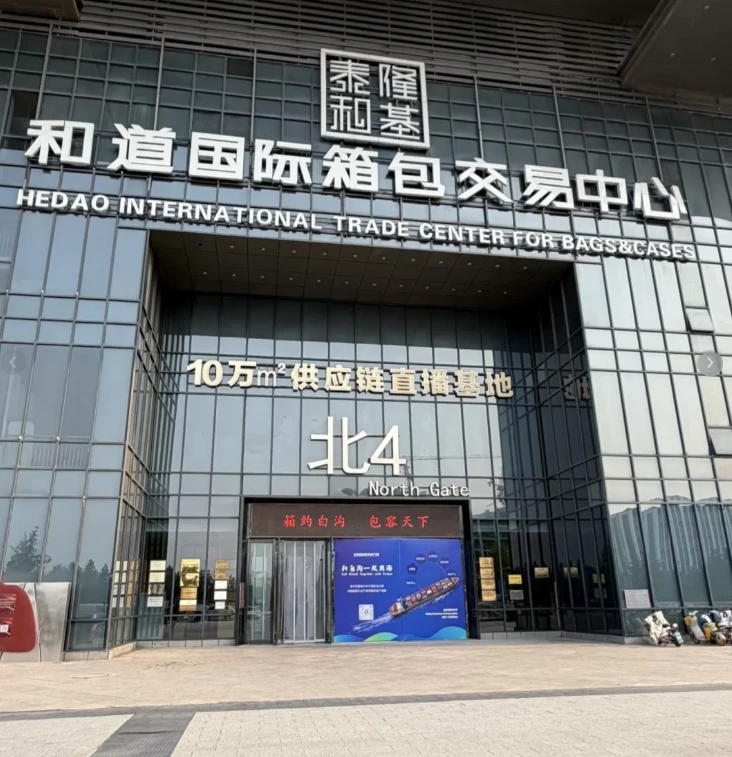
Baigou has more than 7,000 luggage factories and over 30,000 luggage-related production and sales entities, with more than 2.5 million styles and colorways. It holds nearly 30% of China’s domestic market and ships to more than 195 countries and regions; market procurement exports reached 11.457 billion RMB in 2025. Core platforms include Baigou Luggage Trade City, Hedao International Luggage Center — China’s largest single luggage professional market — and a large raw and auxiliary materials market. Fabrics, leather, zippers, hardware and webbing can be sourced nearby, while pattern-making, cutting and sewing, finished-product testing, online e-commerce, offline wholesale and cross-border trade form a complete closed loop. Buyers can handle fabrics, hardware, samples and bulk orders within one area.
Products cover trolley luggage, business briefcases, casual backpacks, ladies’ bags, school bags, outdoor bags and cosmetic cases. The cluster supports customization from buyer artwork, private-label OEM/ODM and mixed-style container consolidation. It serves high-volume standard styles for the Middle East and Eastern Europe as well as fast-turnaround niche styles for cross-border e-commerce. A local cross-border e-commerce park supports rapid sampling, small-batch trial orders and flexible repeat production, while also handling long-term brand bulk orders. Some factories have developed recycled eco-fabric bags and smart charging luggage, and design-patent protection channels have been accelerated.
For overseas buyers, Baigou suits full-category sourcing of trolley luggage, briefcases, backpacks, ladies’ bags, school bags, outdoor bags and cosmetic cases, with artwork-based customization, private label and mixed-container consolidation. Sourcing tips: confirm fabric, leather, hardware and zipper standards; audit whether pattern-making, cutting, sewing and finished-product testing are in-house; use the market procurement trade pilot for mixed-container and mixed-batch shipments; complete pre-production sampling before repeat orders; check IP authorization and design patents; and write lead times, testing standards and after-sales terms into contracts.
