Whether you are interested in learning about local manufacturers, industrial clusters, OEM collaborations, or require assistance with travel planning, hotel recommendations, or other travel arrangements, feel free to contact us at any time. We would be delighted to provide you with advice, free of charge.
| Cluster Name | Linshu – Capital of Chinese Willow Weaving (Linyi, Shandong) |
| History | Sui & Tang dynasties: origin of willow weaving; 1973: first formal export; 2009: awarded Capital of Chinese Willow Weaving; 2024: international World Craft City title |
| Manufacturers | More than 400 willow-weaving entities; 34 enterprises above designated size; 7 national key cultural export enterprises |
| Employment | Around 100,000 local weavers; nearly 30,000 farmers in Caozhuang Town engaged in flexible weaving work |
| Annual Output | 2025 output value 2.805 billion RMB (+18.28%); export 858 million RMB, accounting for over 1/4 of national willow exports |
| National Output Share | No.1 in China for willow weaving production and export volume |
| Export Ratio | Products exported to more than 80 countries and regions |
| Core Products | Storage baskets, laundry hampers, planter sleeves, garden furniture, Christmas gift baskets, cultural handcrafts; mixed composite works with iron, wood, rattan and grass, 20,000+ SKUs |
| Service | OEM / ODM, custom size, colour, pattern, hang tag & gift box, new design development, pre-production sampling, fumigation & phytosanitary documentation, FSC supported |
Linshu willow weaving has verifiable origins dating back to the Sui and Tang dynasties. For over 1,400 years, locals along the Shuhe River harvested willow twigs to weave storage crates and grain containers. During the Yongle reign of the Ming Dynasty, villagers in Qingyun and Baimao wove willow baskets as gifts for family visits, turning weaving into a local custom. In 1973, Linshu willow weaving was included in China’s first national export plan for willow products, with over 200 sets exported that year, filling the blank for China’s willow goods exports. It was awarded “Capital of Chinese Willow Weaving” in 2009 and successfully passed re-evaluation in 2014 and 2019. In January 2024, it received international recognition as “City of Handicrafts Worldwide — Capital of Willow Weaving Craft”.
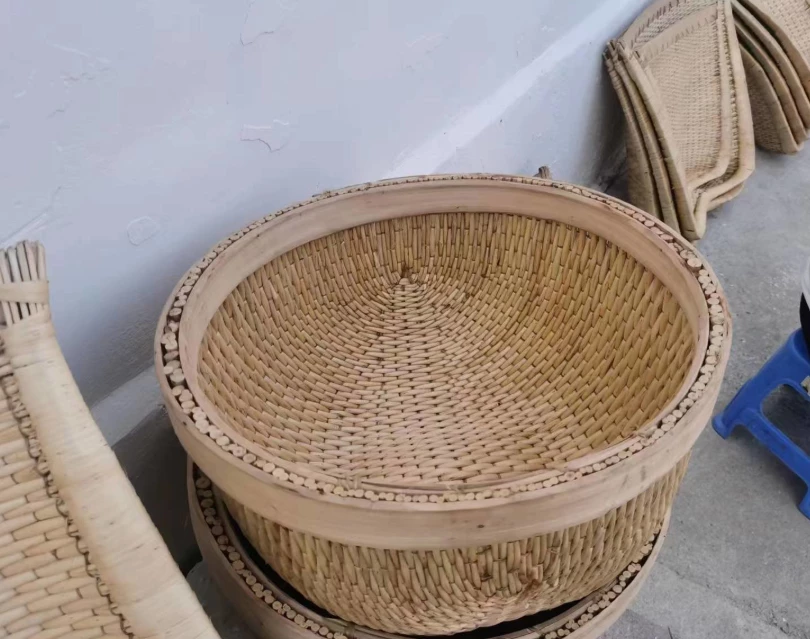
The cluster boasts remarkable industrial scale. In 2025, Linshu’s 34 above-scale willow-weaving enterprises achieved a total industrial output value of 2.805 billion RMB, a year-on-year increase of 18.28%. Exports reached 858 million RMB, accounting for more than one quarter of China’s total willow product exports. Its production and export volume have ranked first nationwide for many consecutive years. The county hosts over 400 willow-weaving business entities, 35 registered brands, and 7 enterprises listed as national key cultural export firms. Products are sold to more than 80 countries and regions (2026 statistics). Representative manufacturers include Linyi Ronghua Cultural & Creative Rattan Decoration, which maintains more than 20,000 SKUs and launches 2,000 new designs annually. Its industrial chain drives nearly 30,000 farmers around Caozhuang Town into flexible employment, lifting their annual income by over 20,000 RMB per capita. Linshu Jinliu has supplied IKEA stores globally since 2003. Qinglang Crafts covers 60,000 ㎡ and has focused on markets in Japan, South Korea, Europe and the United States since 2001.
Raw material is the foundation of willow weaving. The Shuhe River basin is a premium willow planting zone in China. At its peak, Linshu had roughly 100,000 mu of willow plantations (2021 data), with high-yield plots delivering 700 kg of twigs per mu (2022). Caozhuang Town alone holds more than 9,000 mu of willow fields and 15,000 skilled weavers. Qingyun Town operates six standardized planting bases with an annual output exceeding 4 million kg. The local willow twigs feature uniform thickness, pale clean colour and excellent flexibility. After peeling, steaming and dyeing, they are made into white willow and processed willow finished goods. Equally important is the distributed weaving network. In Caozhuang, willow weaving is a widespread household skill. Around 100,000 local residents are engaged in willow processing (2021 data). Rural shared workshops split bulk orders to individual households while supporting central sampling for small orders, enabling stable delivery for full-container peak-season shipments.
As plant-based goods, willow items require strict quarantine compliance for overseas buyers. Linshu holds two critical national certifications: National Foreign Trade Transformation & Upgrade Base and National Demonstration Zone for Quality & Safety of Export Bamboo, Wood, Grass and Willow Products. Export manufacturers complete filing for outbound bamboo-wood-grass-willow enterprises under Linyi Customs (affiliated to Qingdao Customs). Qualified shipments receive phytosanitary, fumigation or disinfection certificates. Customs specialists also guide new exporters on quarantine rules for destination markets. The cluster has rich audit experience for European and American supermarket buyers. Jinliu’s long-term IKEA supply experience sets an industry benchmark. Multiple weaving factories hold FSC chain-of-custody certificates. ISO9001 and social responsibility audits are widely adopted among above-scale manufacturers, and over 30 firms have registered independent brands overseas.
Logistics and sales channels benefit from the large Linyi Trade City ecosystem. In 2025, Linyi’s market procurement trade exports hit 3.916 billion RMB, rising 53.47% year-on-year, supporting mixed small-batch consolidated shipments. Linyi is a national China-Europe Railway Express hub with 27 routes covering 14 European countries. Qilu Express trains loaded with grass and willow crafts run regularly. Highway links directly to seaports, and sea-rail intermodal “direct loading at port” improves logistics efficiency by 30% while cutting costs by roughly 15% (2025 data). Linshu itself is China’s largest willow-weaving e-commerce cluster, containing 1 Taobao Town and 6 Taobao Villages. Enterprises expand sales via cross-border e-commerce and overseas livestreaming. Local authorities actively develop overseas warehousing networks. Relying on Linyi Trade City’s overseas branches in South Korea, Malaysia, Indonesia and Kazakhstan, a dedicated Linshu Willow Weaving Exhibition Center opened in South Korea in 2024.
For international buyers, Linshu’s core strength lies in combining handmade texture with industrialized delivery. Its portfolio covers storage baskets, laundry hampers, planter sleeves, garden furniture, festive Christmas baskets and cultural handicrafts, totalling tens of categories and over 20,000 styles. Willow can be combined with iron, wood, rattan and grass materials. OEM / ODM services support custom sizing, colour schemes, patterns, hang tags and gift packaging. Leading factories release 2,000 new designs each year, with ready items available for modification. Sourcing recommendations: schedule sampling and pre-production confirmation for Christmas seasonal goods from March to May, as production capacity tightens in the second half of the year. Clearly specify fumigation/phytosanitary certificates, mould-proof treatment and FSC coverage in initial contracts. Small trial orders can use market procurement trade or LCL consolidation, while repeat bulk orders benefit from overseas warehouse stocking. Natural material colour variation and handmade tolerance ranges must be confirmed together with pre-production samples.
