Whether you are interested in learning about local manufacturers, industrial clusters, OEM collaborations, or require assistance with travel planning, hotel recommendations, or other travel arrangements, feel free to contact us at any time. We would be delighted to provide you with advice, free of charge.
| Cluster Name | Yiwu – China’s Craft & Artware Trading Capital (Jinhua, Zhejiang) |
| History | 1982: first-generation small commodity market opened; Oct 2002: International Trade City District 1 launched; Jan 2021: awarded “China Craft & Artware Industry Trading Capital” |
| Manufacturers | 10,000+ booths and 10,500+ operators in District 1 alone; leading exporters include Huahong Home Décor, Wangbin Group, Niannianhong Industrial, Dicai Crafts and Zhuoya Trading; 350+ members in the local crafts association |
| Employment | Skilled workforce across decorative painting, frames, artificial flowers, carving, crystal, rosewood furniture and design; Zhuoya alone works with 90+ Russian designers |
| Annual Output | 2025 Yiwu imports & exports: 836.5 billion RMB; exports: 730.7 billion RMB; China Small Commodity City turnover: over 320 billion RMB |
| National Output Share | National-level trading capital for craft and artware; China’s key export gateway for Christmas supplies and festive gifts |
| Export Ratio | Buyers from Europe, the US, the Middle East, Southeast Asia, Russia, Latin America, Japan and Korea; 4,000+ overseas buyers daily in 2025 |
| Core Products | Decorative paintings, photo frames and mirrors, artificial flowers, festive crafts, tourism souvenirs, porcelain and crystal, wood/root/jade carvings, rosewood furniture, DIY diamond paintings, creative embroidery, home wall art, holiday gifts, fridge magnets, IP derivatives |
| Service | Mixed spot-lot purchase and LCL consolidation, small-batch quick response, sampling from buyer artwork, OEM/ODM customization of pattern, material, size, packaging and logo, compliant export via market procurement trade, testing and certification support |
Yiwu sits in central Zhejiang at the eastern edge of the Jinqu Basin. It is the world’s small-commodity distribution hub and a key trading city in the southern wing of the Yangtze River Delta. Unlike kiln-based craft clusters, Yiwu’s arts and crafts industry grew out of trade. The first-generation small commodity market opened in 1982, and International Trade City District 1 began operation in October 2002. Decorative paintings, photo frames, artificial flowers, wood carvings, crystal and rosewood furniture from all over China were gathered into one market and sold worldwide. In January 2021, the China National Light Industry Council awarded Yiwu the title “China Craft & Artware Industry Trading Capital” — the emphasis on “trading” reflects its role as a sourcing hub, order gateway and export channel for craft products.
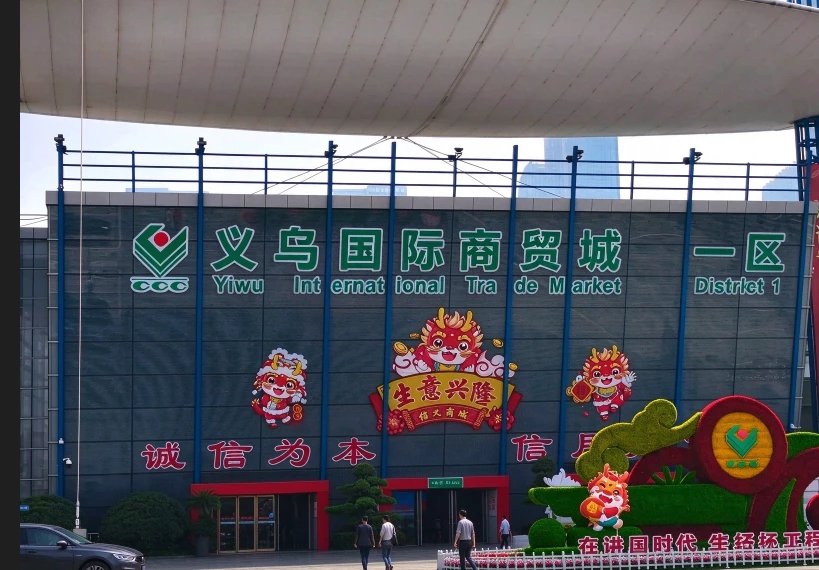
Scale starts with the market. In 2025, Yiwu’s total imports and exports reached 836.5 billion RMB, with exports of 730.7 billion RMB, while turnover at the China Small Commodity City exceeded 320 billion RMB. International Trade City trades 26 major categories, more than 4,200 types, over 30,000 sub-types and 2.1 million SKUs. District 1 covers 420 mu with 340,000 ㎡ of floor space, hosting more than 10,000 booths and 10,500-plus operators. Crafts are concentrated on the third floor — festive crafts, decorative crafts, tourism souvenirs, porcelain and crystal, and photo frames — while the first floor houses artificial flowers and floral accessories.
The product matrix spans decorative paintings, photo frames and mirrors, artificial flowers, festive crafts, tourism souvenirs, porcelain and crystal, wood, root and jade carvings, rosewood furniture, DIY diamond paintings, creative embroidery, home wall art, holiday gifts, fridge magnets and IP derivatives. Yiwu’s model is not single-factory mass production but “market + factory + design” working together: mixed spot-lot purchases, small-batch quick response and sampling from buyer artwork. Buyers can assemble a complete home-decor or festive gift series within one market.
Leading firms include Huahong Home Décor, which makes decorative paintings, mirrors and frames with annual revenue of over 1 billion RMB and about 97% of sales from exports; its clients include Walmart and Home Depot, and it holds 47 patents with a R&D team of nearly 150 and annual R&D spending above 20 million RMB. Its subsidiary Zhejiang Huazhidu is Yiwu’s largest decorative painting manufacturer and obtained a provincial-level enterprise technology center in 2025. Wangbin Group produces decorative paintings, frames, rosewood furniture and decorative materials, with more than 900 patents. Niannianhong Industrial is one of China’s largest R&D and production bases for Chinese-style furniture, using imported rosewood and more than 60 processing steps, with exports to Southeast Asia, Europe and the US. Dicai Crafts focuses on DIY diamond painting and creative embroidery, holding nearly 600 copyrights as of end-2025. Zhuoya Trading specializes in China-Russia trade and works with more than 90 Russian designers on craft development.
Platforms and policies are the other pillar. The Market Procurement Trade model was approved by eight ministries in 2013, and China’s first market procurement customs declaration was issued in Yiwu in November 2014, giving small-batch, multi-batch, invoice-less exports a compliant channel. Yiwu hosts the China Yiwu International Commodities Fair and the China (Zhejiang) Arts & Crafts Masterpieces Expo, the latter founded in 2009 and held for the 13th time in 2025 with cumulative attendance of over one million. The Yiwu Arts & Crafts Industry Association, founded in October 2011, counted more than 350 members by early 2026, covering root carving, jade carving, wood carving, pottery and crystal carving.
Buyers come from around the world. In 2025, Yiwu received more than 4,000 overseas buyers daily, with exports reaching Europe, the US, the Middle East, Southeast Asia, Russia, Latin America, Japan and Korea. Christmas supplies, festive gifts and home decoration are traditional strengths, supported by four parallel channels: cross-border e-commerce, market procurement, trade fairs and overseas warehousing. For craft products, Yiwu functions as a global selection front-end where new designs are test-marketed before large orders are placed. Target buyers include gift wholesalers, home décor suppliers, retail chains, cultural and creative IP owners, hospitality project contractors and cross-border e-commerce sellers. Spot goods support mixed lots and LCL consolidation; customization covers patterns, materials, sizes, packaging and logos, with small-batch quick response a core strength. Sourcing tips: audit factories for ISO9001 and BSCI/Sedex; compliance follows material lines — REACH and California Prop 65, EN71 and CPSIA for children’s or toy items, FDA and LFGB for tableware, fumigation/ISPM15 for wood packaging, destination phytosanitary rules for wood products, and drop testing for glass frames. IP items such as Disney or Marvel require verified authorization, and exports need certificates of origin and destination-market labels.
