Whether you are interested in learning about local manufacturers, industrial clusters, OEM collaborations, or require assistance with travel planning, hotel recommendations, or other travel arrangements, feel free to contact us at any time. We would be delighted to provide you with advice, free of charge.
| Cluster Name | Zhongtai – China’s Bamboo Flute Capital (Yuhang, Hangzhou, Zhejiang) |
| History | 2011: awarded “China Bamboo Flute Town”; 2014: National Geographical Indication Protected Product; 2025: GI certification trademark launched |
| Manufacturers | 160+ flute-making enterprises; 100+ e-commerce businesses; 2,000+ practitioners; leading firms include Lingsheng Musical Instruments |
| Employment | 2,000+ practitioners across bamboo selection, drilling, tuning, engraving, packaging and e-commerce; 30+ “flute second-generation” successors |
| Annual Output | 4.5 million mid-to-high-end bamboo flutes; flute and xiao output value 350–400 million RMB |
| National Output Share | Over 85% of global bamboo flute output; China’s only bitter bamboo germplasm resource bank and national standardized cultivation demonstration zone |
| Export Ratio | Exports to the US, Singapore, Japan, Korea, Malaysia and other Southeast Asian countries; Lingsheng exports over half its output |
| Core Products | Mid-to-high-end bamboo flutes, xiao, flute and xiao accessories, cultural gift flutes |
| Service | OEM/ODM with key, intonation standard, engraving, logo, packaging and flute case customization; teaching, performance and gift flute sourcing; factory audits on bamboo reserves, drying years and in-house tuning; GI and phytosanitary compliance support |
Zhongtai Subdistrict lies in western Hangzhou, Yuhang District, Zhejiang, where the Tonglingqiao area grows 28,000 mu of bitter bamboo. The bamboo has long nodes, round culms and thick walls, and must be shade-dried in ventilated conditions for more than two years before entering the flute workshop. In July 2011, the China National Light Industry Council and China Musical Instrument Association awarded Zhongtai the title “China Bamboo Flute Town”; in 2014 “Zhongtai Bamboo Flute” became a National Geographical Indication Protected Product, and the GI certification trademark was launched in June 2025.
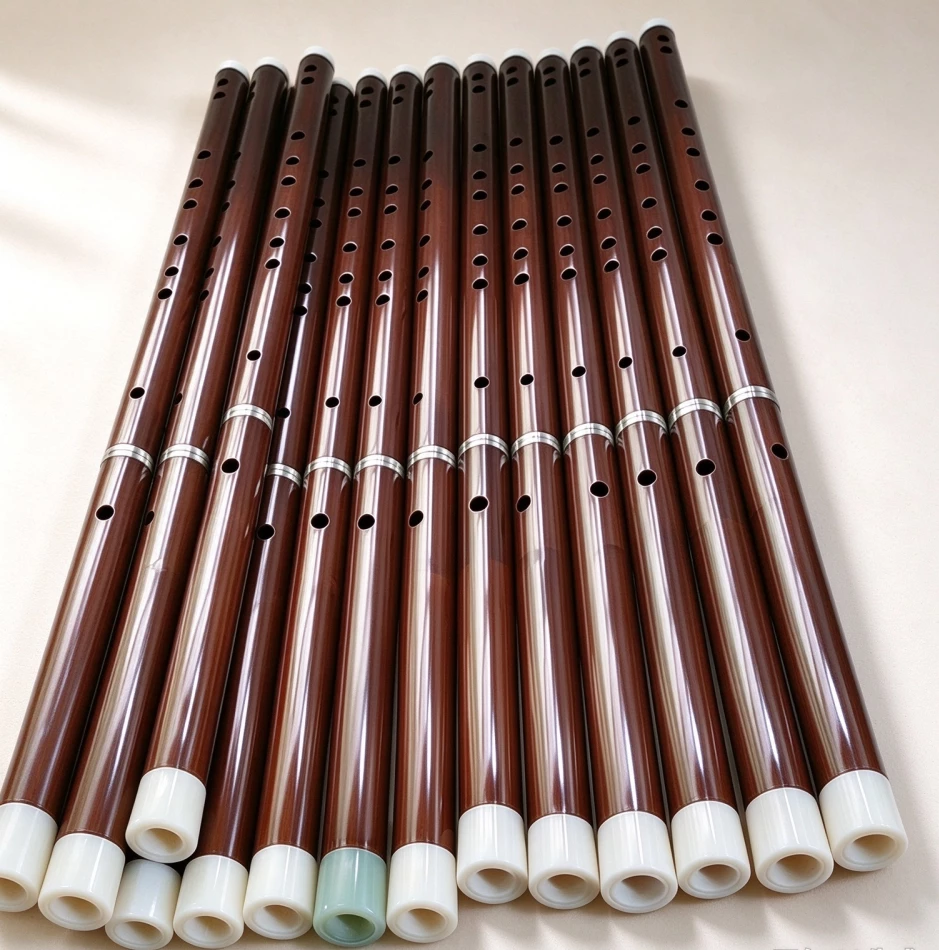
Today Zhongtai hosts more than 160 flute-making enterprises and over 100 e-commerce businesses, employing more than 2,000 people. Annual output of mid-to-high-end bamboo flutes reaches 4.5 million units, with annual flute and xiao output value of 350–400 million RMB, accounting for over 85% of the global bamboo flute total. More than 80 firms run online stores and over 30 do livestreaming, with online sales exceeding 60% and average daily e-commerce orders above 3,000. In 2023 Zijin Village recorded 1.5 million RMB in collective operating income and 53,000 RMB per capita annual income for villagers.
Each flute goes through 72 processes: bamboo selection, sawing, baking, straightening, peeling, drilling, hole carving, tuning, engraving, lacquering, binding and packaging. The most critical step is tuning by ear — tone-hole size and depth must be adjusted to the player’s breath and intonation habits, and machines cannot make the final cuts. Zhongtai has China’s only bitter bamboo germplasm resource bank and is a national standardized demonstration zone for directed bitter bamboo cultivation; Zijin Village produces about 16,000 tonnes of bitter bamboo annually. Specialization is fine enough that some workers only drill holes, some only tune, and others only make flute membranes and packaging.
Among leading figures, Dong Xuehua is president of the Hangzhou Bamboo Flute Industry Association and head of Lingsheng Musical Instruments. Lingsheng produces nearly 30,000 bamboo flutes a year, over half for export to Southeast Asia, Japan and Korea; the Dong family contracts more than 20 mu of bamboo forest but still sends over ten workers experienced in bamboo selection up the mountain to choose materials. Huang Weidong has made flutes for nearly 40 years; his company has only a dozen workers, and he personally handles material selection, pitch setting and tuning. Ding Xiaoming is a inheritor of bamboo flute-making craftsmanship and vice president of the association; his daughter Ding Yuchen returned after graduating from Wuhan Conservatory of Music and set up a studio for flute-making, training, livestreaming and cultural creative products. More than 30 such “flute second-generation” successors are gradually taking over family factories.
Supporting industries now go beyond flutes. Bamboo materials, flute membranes, engraving, packaging and logistics can all be sourced within the subdistrict; the Bamboo Flute Exhibition Hall, Bamboo Music Square, Baileji and Zijin Academy bring in study tours, performances and cultural tourism; flute summer camps, public xiao and flute classes and the Bamboo Flute Talent Culture and Art Exchange Week bring conservatory teachers and performers into the village year after year. Master workshops and university cooperation are turning “knowing how to make” into “making accurately and consistently”. In export markets, Zhongtai flutes reach the US, Singapore, Japan, Korea, Malaysia and other Southeast Asian countries. Entry-level flutes costing tens of RMB and fine flutes costing thousands to tens of thousands of RMB follow two paths: the former relies on e-commerce and wholesale, the latter on the reputation of performers, orchestras and conservatories. Overseas Chinese orchestras, music training institutions and cultural gift buyers are common purchasers.
Sourcing tips: first decide whether you need teaching flutes, performance flutes or cultural gift flutes. Teaching flutes can accept wider tolerances; performance flutes require specified keys (C, D, E, F, G, A), intonation standards and player habits. Engraving, logos, packaging and flute cases can be customized; minimum order quantities for handmade orders depend on the factory and model, and lead times must follow bamboo drying and hand tuning. Factory audits should check three things: bitter bamboo material reserves and drying years, whether tuners are in-house, and whether key processes are outsourced. On compliance, bamboo product exports require confirming destination phytosanitary requirements and whether certificates or treatment proofs are needed; bamboo source legality and GI authorization should also be verified. “Zhongtai Bamboo Flute” is a regional public brand and cannot be used freely. Take samples, blind-listen and compare intonation before discussing volume; every handmade flute sounds different — that is both the risk and why it is worth more than an industrial flute.
